

If you run a manufacturing business, you have probably noticed the old rulebook does not work the way it used to. Digital marketing for manufacturing is no longer a “nice to have” add-on to your sales team; it is quickly becoming the main way buyers find, research, and choose suppliers.
Whether you make industrial fasteners, cold storage panels, wind energy components, or specialty chemicals, your next big client is likely researching you online right now, long before they ever pick up the phone.
This article covers why digital marketing matters for manufacturers in 2026, the core pillars to get right, how the B2B buyer journey works, a step-by-step framework, and how to measure whether it is paying off.
Key takeaways:
- Most B2B buyers complete a large share of their research independently before ever contacting a sales team, according to recent industry surveys.
- Manufacturing SEO and content build trust earlier in the buying journey, when buyers are still comparing options.
- Results from manufacturing SEO typically take three to six months to show up, with qualified RFQs following soon after.
- Tracking cost per qualified RFQ, not just website traffic, is what turns digital marketing into a measurable business investment.
Why Digital Marketing for Manufacturing Matters in 2026
Manufacturing has always been a relationship-driven business. But the way those relationships start has changed completely. Buyers do not wait for a sales rep to call anymore. They search, compare, and shortlist suppliers on their own terms.
How Modern Procurement Decisions Are Made Online
Most industrial buying journeys today begin with a simple Google search or a question typed into an AI chatbot. Procurement teams and engineers look up suppliers, read technical blogs, download spec sheets, and check reviews well before filling out a contact form.
By the time a supplier hears from a prospect, that buyer has often already narrowed the field to two or three names. If your company is not visible during that early research phase, you are simply not in the running. This is exactly where digital marketing for manufacturing companies earns its place. It puts your brand in front of buyers at the exact moment they start looking.
The numbers back this up too. Recent research from 6sense found that buyers now handle roughly 60% of their research on their own before they ever engage a seller, and here’s the part that should worry any manufacturer sitting on the sidelines: the vendor a buyer already favors before that first conversation wins the deal about 80% of the time.
Shifting Away From Traditional Trade Shows to Digital Channels
Trade shows and print catalogs still have a role, but they are no longer the primary source of new business for most manufacturers.
Budgets that once went entirely toward booth space and printed brochures are now being split with SEO, paid search, and content marketing, simply because digital channels are measurable and available every single day of the year, not just for three days at an expo hall.
A well-built website can generate qualified inquiries around the clock, something a trade show booth can never do.
Core Pillars of Digital Marketing for Manufacturing Companies
A strong industrial marketing plan rests on a handful of pillars that work together rather than in isolation.
Search Engine Optimization (SEO) Built for B2B Industrial Buyers
Manufacturing SEO is different from typical e-commerce SEO. It is less about broad consumer keywords and more about precise, technical search terms tied to materials, tolerances, certifications, and applications.
A reliable manufacturing digital marketing company will research the exact phrases engineers and procurement managers type into Google, then build pages, product listings, and blog content around them so your site ranks when it matters most.
From experience: In our work with manufacturing and industrial clients across India, the accounts that gain traction fastest are almost always the ones that publish detailed, application-specific content early, rather than generic “about us” pages. Specificity, not volume, is what earns rankings and buyer trust in this sector.
Technical Web Design and High-Converting RFQ Pages
Your website is often the first real impression a buyer forms of your factory, even if they never step inside it. Clean navigation, fast load times, downloadable spec sheets, and a simple Request for Quotation (RFQ) form all matter. A cluttered or outdated website can quietly push serious buyers toward a competitor with a more professional presence online.
Content Marketing That Simplifies Complex Engineering Concepts
Manufacturing content works best when it breaks complicated processes into language a non-specialist can still follow. Blog posts, case studies, and explainer articles that clearly answer a buyer’s real question earn trust faster than dense technical jargon ever could.
Precision Paid Ads (PPC) Targeting Decision-Makers
Paid search and LinkedIn ads let manufacturers reach purchasing managers and engineers directly, using filters like job title, industry, and company size. These are useful for reaching niche buyers who might never stumble across your site organically.
LinkedIn and Social Proof for Building B2B Brand Trust
LinkedIn has become the informal trade show floor of B2B manufacturing. Sharing plant updates, certifications, client testimonials, and behind-the-scenes content builds the quiet credibility that turns a cold lead into a warm one.
Visualizing the B2B Buyer Journey in Industrial Marketing
Understanding how a buyer moves from curiosity to commitment is the foundation of any good strategy.
Understanding the B2B Manufacturing Funnel
Industrial buying journeys are longer and more considered than typical consumer purchases, often involving multiple stakeholders and several rounds of internal approval.
Awareness: Product Discovery and Search Intent
At this stage, a buyer is simply trying to understand their options, searching broad, informational terms and not yet ready to talk to sales.
Consideration: Spec Sheet Downloads and CAD File Reviews
Here, buyers narrow their list, downloading technical documents and comparing specifications to check whether a supplier’s capabilities genuinely match their project.
Decision: Request for Quotation (RFQ) and Supplier Vetting
By the final stage, the buyer requests pricing and vets suppliers on reliability, certifications, and past client work. Effective B2B digital marketing for manufacturing makes sure your company shows up clearly at every one of these three stages, not just the last one.
Step-by-Step Guide to Digital Marketing for Manufacturing Success
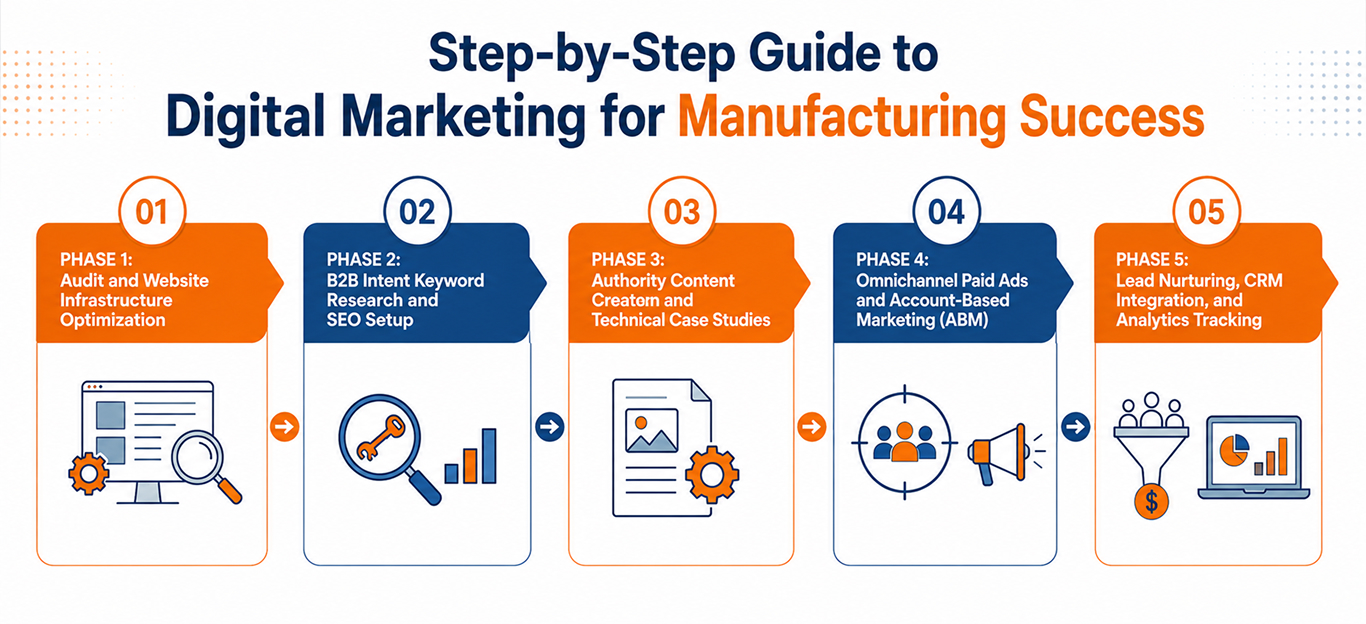
Rather than treating SEO, ads, and content as separate projects, the strongest results come from following a structured, phased approach.
The 5-Phase Digital Growth Framework
Phase 1: Audit and Website Infrastructure Optimization
Audit your current site for speed, mobile usability, broken links, and outdated content, so every later effort builds on a solid foundation.
Phase 2: B2B Intent Keyword Research and SEO Setup
Identify the exact search terms your buyers use, then map them to specific pages, product categories, and blog topics.
Phase 3: Authority Content Creation and Technical Case Studies
Publish case studies, application guides, and FAQs that answer real buyer questions and demonstrate proven expertise.
Phase 4: Omnichannel Paid Ads and Account-Based Marketing (ABM)
Layer in LinkedIn and Google Ads, and for larger accounts, consider account-based marketing to target specific companies with tailored messaging.
Phase 5: Lead Nurturing, CRM Integration, and Analytics Tracking
Connect website forms to a CRM, set up nurture emails for buyers not yet ready to purchase, and track every step so you know what is actually working.
How Long Does It Take to See Leads From B2B Industrial SEO?
Most manufacturers see meaningful movement in rankings and traffic within three to six months, with qualified RFQs typically picking up between months four and eight.
Manufacturing SEO takes longer than consumer SEO because search volumes are lower and buying cycles are longer. 6sense’s 2025 research puts the average B2B buying cycle at around ten to eleven months.
But the leads it produces are far more qualified once they arrive. Consistency is what separates companies that see real results from those that give up too early.
Measuring ROI in Digital Marketing for Manufacturing
None of this matters if you cannot tell whether it is working, which is why measurement deserves just as much attention as execution.
Key Metrics That Matter Most to Industrial Leadership
Website traffic is a starting point, but leadership teams care more about qualified RFQs, cost per lead, inquiry-to-quote conversion rate, and ultimately, closed sales. These are the numbers that connect marketing activity to real revenue.
How to Track Pipeline Value and Cost Per Qualified RFQ
Tagging every inquiry by source, whether it came from organic search, paid ads, or a referral, lets you calculate exactly what each channel is contributing to your pipeline.
Over time, this data tells you where to invest more and where to pull back, turning digital marketing services for manufacturers into a measurable, accountable investment rather than a guessing game.
The right digital marketing services for manufacturers treat reporting as a core deliverable, not an afterthought.
Scaling Growth with Global Vincitore LLP: Premier Digital Marketing for Manufacturing Partner

Building and running all of this in-house takes time, specialized skill, and constant testing. These are the resources that most manufacturing teams would rather spend on core operations, and this is exactly the gap we help close.
Why Leading Manufacturers Trust Global Vincitore LLP
Global Vincitore is a manufacturing digital marketing company based in Ahmedabad with over nine years of experience helping industrial and B2B brands grow online. Our team understands the challenges manufacturers face, from long sales cycles to technical buyer education, and we build strategies around those realities rather than a one-size-fits-all playbook.
The Global Vincitore Approach to High-Intent B2B Lead Generation
Our approach combines SEO, content marketing, paid advertising, and website optimization under one roof, so every channel works together instead of in silos. We focus on B2B digital marketing for manufacturing, built to attract high-intent buyers, not just generic traffic. Our services are backed by transparent reporting so you always know what is being done and why.
Transform Your Industrial Growth with Data-Driven Digital Strategies
If your manufacturing business is ready to move beyond referrals and trade shows and build a predictable digital pipeline, we would be glad to help. You can learn more about our work with manufacturers at globalvincitore.com and see how a dedicated digital marketing for manufacturing companies partner can support your growth.
Conclusion
Manufacturing buyers are researching, comparing, and shortlisting suppliers online, whether your company is actively participating in that process or not. Getting digital marketing for manufacturing right means combining SEO, strong web design, useful content, precision ads, and consistent social proof into one connected strategy, guided by a clear understanding of the buyer journey and measured honestly against real business outcomes.
Manufacturers who commit to this approach today are the ones who will keep winning RFQs long after their competitors are still relying on the trade show floor alone.