

If you run a manufacturing company, you have probably noticed that buyers now do their homework online before they ever call your sales team. This is exactly why digital marketing for manufacturing has become just as important as the quality of what you build on the factory floor. Buyers search for parts, machinery, and suppliers on Google long before they fill out a contact form.
The good news is that you do not need a massive budget to compete. Many manufacturers assume that ranking well requires expensive ad campaigns or a large in-house team. In reality, a clear plan and steady effort can help you understand how to rank manufacturing websites on Google without draining your budget.
This article walks you through the technical foundation, the content strategy, and the lead-generation steps that make it happen.
How Can Manufacturers Build a Strong Technical SEO Foundation?
Before you write a single blog post, your website needs to work properly. Search engines reward sites that load fast, work well on phones, and are easy to navigate. This is the real foundation of any ROI-focused digital marketing for manufacturing plan.
Fix Website Speed and Mobile Experience First
Most manufacturing websites are built to show technical detail, not speed. Large product images, heavy PDF catalogs, and outdated plugins can slow a page down. Compress your images, remove unused plugins, and test your site on a phone, not just a desktop. A slow website loses buyers before they ever see your products.
Clean Up Site Structure for Complex Product Catalogs
Manufacturers often sell hundreds of parts or machine variants, which can turn a website into a maze. Group similar products under clear categories, use simple URLs, and make sure every page is reachable within three clicks of the homepage. A clean structure helps buyers find what they need and helps Google understand what your business actually makes.
Implement Schema Markup for Industrial Equipment
Schema markup is a small piece of code that tells search engines exactly what a page is about, such as a product, price, or specification. For industrial equipment pages, product schema and FAQ schema help your listings stand out in search results, and it also makes your pages easier for AI tools and LLM platforms to read correctly.
SEO teams that have actually worked with manufacturers understand things a generic marketing agency might miss, like long buyer cycles, RFQ-based enquiries, and technical spec sheets. That hands-on experience shapes better decisions than theory alone, and it is what separates real expertise from guesswork.
The 5-Step Low-Cost SEO Workflow for Manufacturers
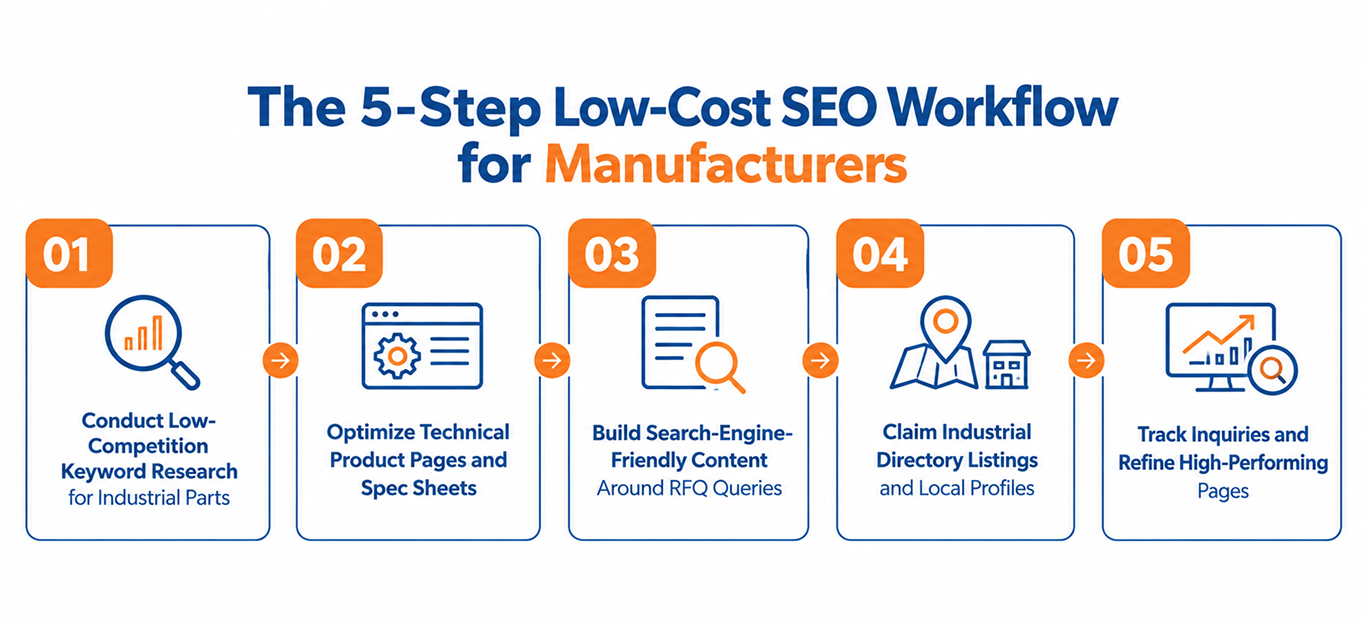 Once your technical foundation is solid, follow a simple, repeatable workflow. This kind of step-by-step digital marketing for manufacturing does not require a large team or a big budget, just consistency.
Step 1: Conduct Low-Competition Keyword Research for Industrial Parts
Skip broad, expensive keywords and look for specific terms your buyers actually type, like part numbers, material grades, or “custom [product] manufacturer in [city].” These long-tail keywords have less competition and attract buyers closer to placing an order.
Step 2: Optimize Technical Product Pages and Spec Sheets
Every product page should list clear specifications, dimensions, materials, and use cases in plain text, not just inside a PDF. Search engines cannot read scanned PDFs easily, so put the key details directly on the page. This one change often improves rankings faster than anything a manufacturing digital marketing company typically recommends first.
Step 3: Build Search-Engine-Friendly Content Around RFQ Queries
Buyers often search using questions like “how much does [product] cost” or “best supplier for [material].” Write short, honest content that answers these questions directly, and link it to the matching product page. This is one of the simplest, lowest-cost forms of digital marketing for manufacturing.
Step 4: Claim Industrial Directory Listings and Local Profiles
List your business on industrial directories, trade association websites, and your Google Business Profile. These listings build trust signals and often rank for local searches like “manufacturer near me” or “supplier in [state],” and most of them cost nothing.
Step 5: Track Inquiries and Refine High-Performing Pages
Use simple tools like Google Analytics and Search Console to see which pages bring in real enquiries, not just visits. Double down on what works, and update or remove pages that get traffic but no leads. This is exactly how to rank manufacturing website on Google becomes a repeatable process instead of a guessing game.
What Is the Best Content Strategy for Manufacturing SEO?
Content is what turns a technically sound website into one that actually ranks. The best digital marketing for manufacturing content strategy answers real buyer questions in plain language, not marketing jargon.
Target High-Intent Technical Keywords Over Generic Terms
A generic keyword like “steel parts” is hard to rank for and attracts the wrong audience. A specific keyword like “CNC machined steel brackets for automotive” attracts buyers who already know what they need. This kind of targeting sits at the heart of effective digital marketing for manufacturing.
Create Detailed Product and CAD Specification Pages
Buyers and engineers often search for exact specifications before they request a quote. Publish detailed spec sheets, tolerances, and CAD file downloads directly on your product pages. Accurate, detailed pages also help AI search tools summarize your products correctly when buyers ask them for supplier recommendations.
Answer Common B2B Buyer Questions Directly
Write short sections that answer real questions, such as lead times, minimum order quantities, and certifications. Keep the language simple and avoid jargon where possible. Clear answers build trust with buyers and are also easier for search engines and LLM platforms to quote.
Trustworthiness matters just as much as keywords. Publishing real project details, verified certifications, and named contacts on your website signals to both buyers and search engines that your business is legitimate and accountable, not an anonymous listing.
How Do You Turn Manufacturing Website Visitors Into Qualified Leads?
Ranking well is only half the job. The other half is turning that traffic into real enquiries from serious buyers.
Add Clear Request-for-Quote (RFQ) Buttons Across Key Product Pages
Do not make buyers hunt for a contact form. Place a simple RFQ button on every product and category page, and keep the form short: name, company, email, and requirement. Fewer fields usually means more completed forms.
Use Downloadable Spec Sheets and Case Studies to Capture Email Leads
Offer downloadable PDFs of spec sheets or case studies in exchange for an email address. This gives you a way to follow up with buyers who are not ready to request a quote yet, while keeping your brand in front of them.
Display Trust Signals, Certifications, and Client Testimonials Promptly
Show ISO certifications, client logos, and short testimonials near the top of key pages, not buried at the bottom. Manufacturing buyers are cautious, and visible proof of reliability is often the deciding factor. This is exactly the kind of guidance a manufacturing digital marketing company gives its clients daily.
How Global Vincitore LLP Helps Manufacturers Scale Organic Traffic

Global Vincitore LLP works with manufacturing and industrial businesses that want practical, budget-friendly digital marketing for manufacturing, rather than generic marketing packages. The team focuses on understanding a manufacturer’s product range, buyer cycle, and target regions before building an SEO or content plan, instead of applying the same template to every client.
Tailored Digital Marketing Strategies for Industrial Brands
Every manufacturer has a different product mix, so Global Vincitore LLP builds strategies around each client’s actual catalog, keywords, and competitors instead of copy-paste plans. This approach is what separates a genuine manufacturing digital marketing company from an agency running the same playbook for every industry.
Proven Frameworks for Lead Generation and SEO Growth
From technical SEO fixes to RFQ-focused content and directory listings, Global Vincitore LLP follows the same practical framework covered in this article, adapted to each client’s website and market. The goal is always measurable enquiries, not just higher traffic, which is the whole point of good digital marketing for manufacturing.
Partnering with Global Vincitore LLP for Technical SEO Success
Manufacturers who want to know how to rank manufacturing website on Google without a big budget can reach out to Global Vincitore LLP for a practical, no-jargon assessment of their website’s current gaps and opportunities.
Authority builds over time. Working consistently on a website’s technical health, content quality, and buyer-focused pages, month after month, is what earns steady rankings, rather than any shortcut or one-time fix.
Final Thoughts on Growing Your Industrial Website Organically
You do not need a massive marketing budget to grow your manufacturing business online. A clean, fast website, honest content that answers real buyer questions, and a steady follow-up process can carry you a long way.
Treat digital marketing for manufacturing as an ongoing habit rather than a one-time project, and the results will compound over time. Start with the technical basics, build content around real buyer questions, and keep refining based on what actually brings in enquiries.
FAQs
1. How can manufacturers compete with larger companies in online search?
Manufacturers can focus on specific long-tail keywords, technical product searches, and niche buyer requirements where competition is lower and search intent is stronger.
2. Why are technical specifications important for manufacturing websites?
Detailed specifications help engineers and buyers evaluate products before contacting a supplier and provide search engines with clear, structured information about the product.
3. How can manufacturers improve trust with potential B2B buyers online?
Displaying certifications, verified project information, client testimonials, technical expertise, and clear company contact details can help establish credibility.
4. What type of content can help manufacturers attract buyers earlier in the purchasing process?
Content addressing questions about pricing, lead times, minimum order quantities, materials, certifications, and product selection can capture buyers while they are researching suppliers.
5. How long does it take to see results from manufacturing SEO?
SEO results generally build gradually. Consistent improvements to technical SEO, product content, and buyer-focused pages can help establish stronger organic visibility over time rather than relying on one-time changes.